


Time to increase glyphosate residues in our food, or past time to update Glyphosate’s risk assessment?
by Stephanie McKee
Did you know that New Zealand Food Safety wants to increase the maximum allowable residue (MAR) level of glyphosate in foods one-hundred fold? (1)
For whose benefit? Not for the health and safety of consumers, that’s for sure. The Environmental Law Initiative states:
“There are around 90 different formulations of glyphosate-based herbicide in Aotearoa. In many of these formulations, glyphosate is mixed with other chemicals that are designed to maximise glyphosate’s effects. Many of these co-formulants are known to be more toxic than glyphosate itself and can also act to increase glyphosate’s toxicity. The “forever chemical,” POEA (Polyethoxylated tallow amine), is an example of a highly controversial co-formulant that is currently available in New Zealand despite being banned overseas”
Some observers assume that the proposed increase in residue levels is in preparation for introducing genetically engineered, Roundup ready crops into GE Free Aotearoa.
Some good news: The Environmental Law Initiative (ELI) is challenging the Environmental Protection Authority (EPA) with a judicial review in the Supreme Court. The ELI’s case asserts that the EPA’s decision not to do an updated risk-assessment on glyphosate is unlawful, given new scientific evidence and research. The last time the EPA did a proper risk-assessment on Glyphosate was in the 1970s and they cannot even find the records for it! (2)
Roadside Spraying on the Coromandel Peninsula
Last time I asked, our local Council was spending over a million dollars annually on road-side spraying on the Coromandel Peninsula, and the spray being used was AG-Pro Glyphosate 500. The manufacturer’s SDS Safety Data Sheet calls Glyphosate ‘ecotoxic; and instructs that it must be kept out of ‘aquatic systems’ .
‘Prevent from entering drains, waterways or sewers. If spill does enter waterways immediately contact local authority.” (5)
So who do you contact when it is the local authority’s contractors themselves who are spraying hundreds of kilometers of roadside drains on the Coromandel Peninsula?
Why should Glyphosate be subject to an updated risk-assessment?
The Parliamentary Commissioner for the Environment, Te Kaitiaki Taiao a Te Whare Pāremata, Simon Upton, explains this clearly in his March 2022 report, ‘Knowing What’s Out There: Regulating the Environmental Fate of Chemicals’:
“The rules about how a chemical can be used shouldn’t be static – we need to be able to adapt as new information comes to light. Restrictions should be based on the latest science and informed by New Zealand-specific data on use and impact.” (3)
Some of this recent independent evidence about Glyphosate is very concerning. (Independent evidence is not funded and supplied by the manufacturer, Bayer.) The ELI has gathered independent scientific evidence for their judicial review and it should make alarm bells ring:
“There is evidence that glyphosate and glyphosate-based herbicides have negative impacts on a wide range of taxonomic groups including bees, soil microbiota, aquatic invertebrates, fish, non-target plants, terrestrial invertebrates, and vertebrates.
Our application also collates independent scientific evidence of glyphosate and glyphosate- based herbicides’ impacts on the human nervous system, human endocrine system, and as a probable human carcinogen. For example, a recent meta-analysis showed that individuals exposed to glyphosate-based herbicides have a 41% increase in risk for non-Hodgkin lymphoma.’ ( 5)
| Actions: Download your Spray Free Zone Sign here and post it up on your roadside verge. Plant native pollinators for the bees. https://floraandfaunaaotearoa.co.nz/wp-content/uploads/sprayfreesign.pdf How to use the TCDC No-Spray register: contact TCDC Customer Services on 07 868 0200. https://www.tcdc.govt.nz/Our-Services/Wildlife-Insects-and- Vegetation/No-Spray-Register |
Poison-Free Coromandel, not only ‘Good for your Soul’ but also ‘Good for your Health’.
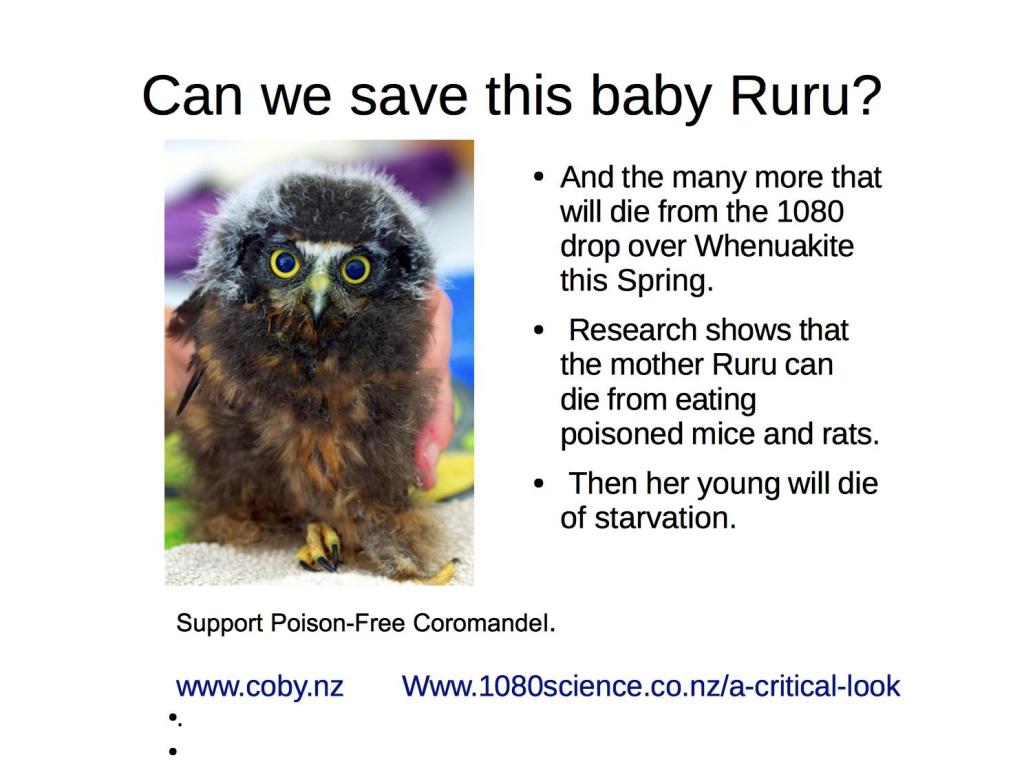
In 2023, COBY presented to the Colville Coromandel Community Board a proposal and vision for a Poison-Free Coromandel, putting the case that a poison-free zone would be not only good for our health but also good for eco-tourism, a growing niche market for Peninsula businesses.
Besides tourism, there is the local honey industry to consider. In 2021, Japan blocked shipments of New Zealand honey after testing found traces of glyphosate exceeding its standard of 0.01 milligrams per kilogram. (6)
Do visitors to the Coromandel really enjoy seeing all the road edges, drains, picnic tables and even children’s playgrounds with the toxic yellowed sprayed edges?
Wouldn’t our tourist guests and local residents alike prefer to see a sign saying,
Welcome to Poison-Free Coromandel.
Good for your Soul.
Good for your Health.
Good for the Planet.
References:
(1) Increasing Glyphosate residue limits: https://www.rnz.co.nz/news/national/561251/nz-food-safety-proposes-increasing-residue-limits-of-insecticides-pesticides-in-food
(2) Environmental Law Initiative: https://www.eli.org.nz/cases/glyphosate
(3) Parliamentary Commissioner for the Environment: https://www.pce.parliament.nz/publications/regulating-the-environmental-fate-of-chemicals
(4) Safety Data Sheet for Agpro Glyphosate: https://agpro.co.nz/downloads/sds-grasidim-qreyp.pdf
(5) https://www.sciencedirect.com/science/article/abs/pii/S1383574218300887?via%3Dihub
(6) Honey exports at risk: https://www.rnz.co.nz/news/country/434807/japan-warns-it-will-block-nz-honey-shipments-if-glyphosate-limits-breached


 Coromandel Our Backyard
You must be logged in to post a comment.